Python Data Structures — Course Overview & Key Highlights
Course introduction
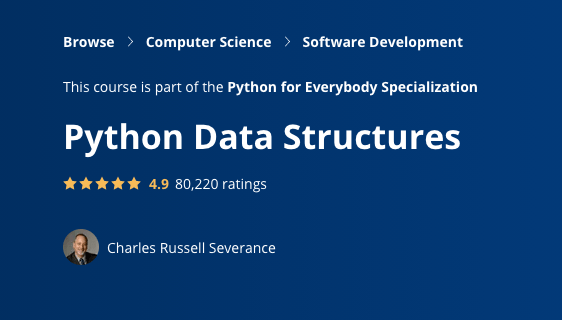
Python Data Structures is a beginner-friendly course offered on Coursera and taught as part of the Python for Everybody Specialization.
This course focuses on the core built-in data structures of Python, helping learners move beyond basic procedural programming into real-world data handling and analysis. It covers how to use lists, dictionaries, tuples, and files to store, organize, and process data efficiently using Python 3.
Course details
- Platform: Coursera
- Level: Beginner
- Language: English
- Duration: ~2 weeks (flexible schedule, ~10 hours/week)
- Modules: 7
- Rating: ★4.9 / 5
- Learners enrolled: 1,160,291+
- Certificate: Shareable Career Certificate included
- Assessment: 5 assignments (AI-graded)
Key highlights
- Learn Python data structures from scratch
- Covers Chapters 6–10 of the Python for Everybody textbook
- Hands-on practice with real Python programs
- Read and write data using files
- Store and manipulate data using lists, dictionaries, and tuples
- Beginner-friendly explanations with practical examples
- Certificate can be added to LinkedIn, resume, and CV


What you will learn
Python Data Structures Fundamentals
- Principles of data structures and how they are used
- Understanding how Python organizes and stores data
Working with Built-in Structures
- Lists for storing and processing collections of data
- Dictionaries for key/value data storage
- Tuples for fixed, multi-value data handling
Data Processing & Analysis
- Sorting and looping through structured data
- Performing multi-step data tasks efficiently
- Basic data analysis using Python structures
File Handling
- Reading data from files
- Writing processed data back to files
- Working with structured text data
Skills you’ll gain
- Python Programming
- Data Structures
- Data Analysis
- Data Manipulation
- Data Processing
- Development Environment Setup
- Software Installation
Frequently asked questions (FAQ)
Q — Is this course suitable for absolute beginners?
A — Yes. No prior programming experience is required.
Q — Does this course teach Python 3?
A — Yes. All examples and assignments use Python 3.
Q — Will I get a certificate?
A — Yes. You receive a shareable career certificate from Coursera.
Q — Is this course part of a specialization?
A — Yes. Enrollment also includes the Python for Everybody Specialization.
Q — How long does it take to complete?
A — Around 2 weeks, but you can learn at your own pace.
Why this course is worth it
This course is ideal for learners who want to build strong Python foundations before moving into data science, automation, or backend development. The focus on real data handling—rather than just syntax—makes it highly practical and career-relevant.
Final verdict
If you’re new to Python and want to truly understand how data is stored, organized, and processed, this course is an excellent starting point. It’s simple, well-structured, and trusted by over a million learners worldwide.
Affiliate Disclaimer: Some links in this post may be affiliate links. This means we may earn a small commission at no extra cost to you. These commissions help support the site — thank you for your support!