Master Microservices with Spring Boot and Spring Cloud
Overview
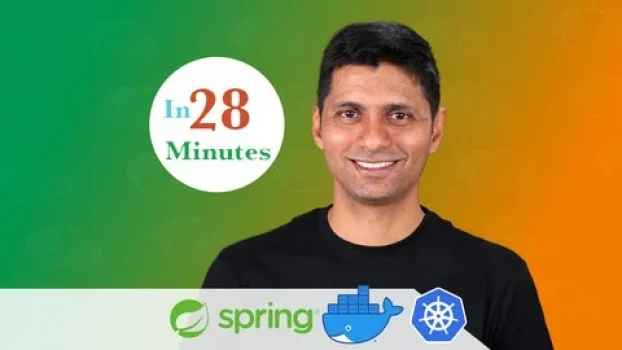
This course provides a complete, practical introduction to building microservices using Java and the Spring ecosystem. Instead of focusing only on theory, it walks learners through designing, developing, containerizing, and orchestrating real-world microservices using Spring Boot, Spring Cloud, Docker, and Kubernetes.
The learning approach is progressive and beginner-friendly for developers who already know Java and Spring, while still covering advanced production concepts such as service discovery, fault tolerance, distributed tracing, and centralized configuration.
Course Snapshot
- Instructor: in28Minutes Official
- Students enrolled: 293,346
- Content length: ~22 hours
- Difficulty level: Beginner to Intermediate
- Language: English (Closed Captions available)
- Certification: Included
- Access: Full lifetime access (mobile & TV supported)
What This Course Actually Covers
Rather than treating microservices as isolated services, this course focuses on end-to-end microservices architecture—from REST API design to cloud-native deployment.
Key areas include:
- Building RESTful web services using Spring Boot
- Designing and implementing microservices with Spring Cloud
- Containerizing services using Docker
- Orchestrating microservices with Kubernetes
- Applying resilience, monitoring, and observability patterns
![[NEW] Master Microservices with SpringBoot,Docker,Kubernetes](https://elearn.interviewgig.com/wp-content/uploads/thumbs_dir/3984552_b313_6-rh5fire77j4ye3ez5dwcprw1pc59id8thztpjtl6da.webp)
Skills & Concepts You’ll Work With
REST API & Spring Boot Foundations
- Designing RESTful APIs and web services
- Exception handling, validation, filtering, and HATEOAS
- API versioning and OpenAPI documentation
- Monitoring services using Spring Boot Actuator
Microservices with Spring Cloud
- Service discovery using Eureka Naming Server
- Centralized configuration with Spring Cloud Config Server
- Client-side load balancing and API Gateway patterns
- Simplifying service communication using Feign REST Client
Resilience & Observability
- Fault tolerance using Resilience4J
- Distributed tracing with Zipkin
- Monitoring and diagnosing microservices behavior
Containers & Orchestration
- Building Docker images for microservices
- Running containerized microservices locally
- Orchestrating microservices with Kubernetes
- Understanding dynamic scaling and service interaction
Who This Course Is Best Suited For
- Java developers new to microservices architecture
- Spring developers moving from monoliths to microservices
- Backend engineers wanting hands-on Docker and Kubernetes experience
- Learners preparing for microservices-focused interviews
- Professionals aiming to build cloud-ready Java applications
Common Questions Learners Ask
Do I need prior microservices experience?
No. The course assumes Java and Spring knowledge but starts microservices from the basics.
Is Docker and Kubernetes experience required?
No. Both Docker and Kubernetes are taught from scratch in the context of microservices.
Is this course practical or theory-heavy?
It is highly practical, with real implementations and working examples.
Does it cover production-ready patterns?
Yes. Topics like service discovery, fault tolerance, tracing, and configuration management are covered.
Is a certificate included?
Yes. A certificate of completion is provided.
Practical Value
What makes this course stand out is its integration-first approach. Learners don’t just build microservices—they understand how services communicate, scale, fail, recover, and operate in real production-like environments using modern Spring Cloud patterns.
Final Thoughts
If you want a complete, hands-on path to mastering Java microservices, this course offers a structured and beginner-friendly journey through REST APIs, Spring Boot, Spring Cloud, Docker, and Kubernetes. It’s an excellent foundation for building scalable, cloud-native Java systems.
Affiliate Disclaimer: Some links in this post may be affiliate links. This means we may earn a small commission at no extra cost to you. These commissions help support the site — thank you for your support!