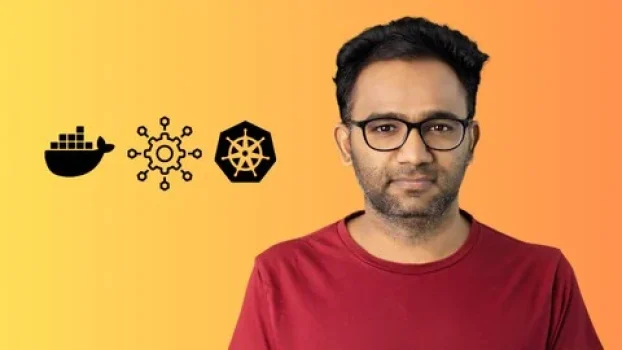
Master Microservices with Spring Boot, Docker & Kubernetes
Overview
This course is designed for developers who want a complete, production-focused understanding of microservices architecture using the modern Java ecosystem. Instead of stopping at theory, it walks through how real-world microservices are designed, secured, deployed, monitored, and scaled using Spring Boot, Docker, and Kubernetes.
The learning style is structured and hands-on, helping learners clearly understand how microservices differ from monolithic systems and how cloud-native principles are applied in enterprise environments.
Course Snapshot
- Instructor: Eazy Bytes
- Students enrolled: 88,107
- Content length: ~40.5 hours
- Difficulty level: Intermediate to Advanced
- Language: English (Arabic auto captions available)
- Certification: Included
- Access: Full lifetime access (mobile & TV supported)
What This Course Actually Covers
Rather than focusing on isolated tools, the course explains how multiple technologies work together in a real microservices ecosystem. Learners build and manage microservices from development to deployment using industry-standard practices.
Core coverage includes:
-
Microservices architecture fundamentals and design principles
-
Building production-ready services using Spring Boot and Spring Cloud
-
Containerization with Docker and orchestration using Kubernetes
-
Observability, resilience, and security in distributed systems


Skills & Concepts You’ll Work With
Microservices Architecture
- Differences between monolithic, SOA, and microservices architectures
- Cloud-native application concepts and the 12-factor methodology
- Designing scalable and loosely coupled services
Spring Boot & Spring Cloud
- Developing microservices with Spring Boot
- Configuration management using Spring Cloud Config Server
- Service discovery and registration with Eureka
- API routing and cross-cutting concerns using Spring Cloud Gateway
Resilience, Monitoring & Observability
- Building fault-tolerant services using Resilience4J
- Implementing monitoring and logging with Prometheus, Grafana, Loki, Tempo, and Promtail
- Understanding observability in distributed systems
Security & Event-Driven Systems
- Securing microservices using OAuth2, OpenID Connect, and Spring Security
- Building event-driven microservices with RabbitMQ, Kafka, Spring Cloud Stream, and Functions
Containers & Orchestration
- Creating Docker images and running containers
- Managing microservices with Kubernetes
- Packaging and deploying applications using Helm
Who This Course Is Best Suited For
- Java developers moving from monolithic to microservices architecture
- Spring Boot developers aiming for cloud-native expertise
- Backend engineers working with Docker and Kubernetes
- Professionals preparing for enterprise microservices roles
- Developers who want real-world, production-level microservices skills
Common Questions Learners Ask
Do I need prior Java or Spring knowledge?
Yes. A basic understanding of Java and the Spring framework is required.
Is this course theoretical or practical?
It is highly practical, focusing on real implementation patterns used in production systems.
Does the course cover Kubernetes in depth?
Yes. Kubernetes is covered as a core component of microservices deployment and orchestration.
Will I learn how to secure microservices?
Yes. The course covers OAuth2, OpenID Connect, and Spring Security for microservices.
Is a certificate included?
Yes. A certificate of completion is provided.
Practical Value
What makes this course stand out is its end-to-end microservices approach. Instead of learning tools in isolation, learners see how Spring Boot, Spring Cloud, Docker, Kubernetes, and observability tools work together to form a complete microservices platform suitable for real enterprise environments.
Final Thoughts
If you’re looking to master microservices using Java and modern cloud-native technologies, this course provides a deep, structured, and practical learning path. It’s especially valuable for developers who want to build resilient, secure, and scalable microservices the way they’re done in real production systems.
Affiliate Disclaimer: Some links in this post may be affiliate links. This means we may earn a small commission at no extra cost to you. These commissions help support the site — thank you for your support!