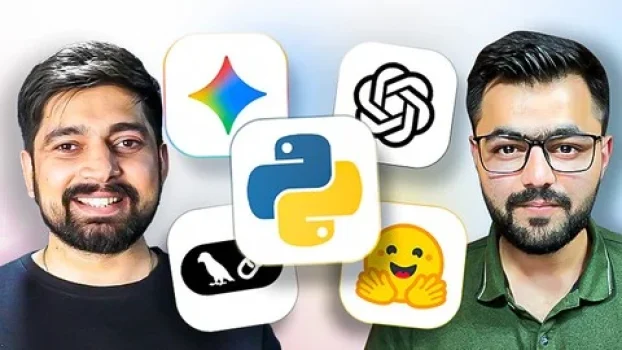
Full Stack Generative & Agentic AI with Python
A Hands-On Program to Build Modern AI Applications Using LLMs, Agents, RAG & Vector Databases
Course Overview
Full Stack Generative & Agentic AI with Python is a practical, implementation-focused program designed for learners who want to build real-world AI applications, not just understand AI concepts at a surface level.
The course takes a full-stack approach to modern AI development — starting with Python fundamentals and gradually moving into Large Language Models (LLMs), agent-based systems, retrieval-augmented generation (RAG), and scalable AI deployment.
Rather than treating AI as a black box, the program explains how models work internally, how they interact with tools and data, and how complete AI-powered systems are designed in production environments.
Key Course Details
- Level: Beginner to Advanced
- Instructors: Hitesh Choudhary, Piyush Garg
- Language: English
- Total Duration: ~32+ Hours
- Students Enrolled: 24,000+
- Rating: ⭐ 4.5 / 5
- Certificate: ✅ Yes
- Access: Lifetime (Mobile & TV)


What You Will Learn
Python Foundations for AI Development
- Python programming from scratch
- Writing clean, maintainable code
- Structuring AI applications effectively
Developer Tools & Workflows
- Using Git for version control
- Managing environments and deployments
- Containerizing applications for consistency
Understanding Large Language Models
- How LLMs process text internally
- Tokenization, embeddings, and attention mechanisms
- High-level understanding of transformer-based models
Prompt Engineering Techniques
- Zero-shot, one-shot, and few-shot prompting
- Structured and persona-based prompts
- Designing prompts for reliable AI behavior
Working with AI APIs
- Integrating LLM APIs into Python applications
- Building AI-powered features programmatically
- Managing responses, inputs, and structured outputs
Retrieval-Augmented Generation (RAG)
- Connecting AI models with external knowledge
- Using vector databases for semantic search
- Designing RAG pipelines for factual accuracy
Agentic AI Systems
- Building AI agents that can reason and act
- Designing stateful AI workflows
- Managing multi-step AI decision-making
Orchestrating AI Workflows
- Structuring complex AI systems with graphs
- Handling memory, checkpoints, and state
- Designing modular and extensible AI pipelines
Deployment & Scaling
- Running AI models locally and in containers
- Deploying AI applications reliably
- Understanding production considerations
Learning Style & Structure
- Hands-on, code-first learning approach
- Concepts explained clearly before implementation
- Gradual progression from basics to advanced systems
- Focus on building complete, usable AI applications
- Emphasis on modern industry practices
Who This Course Is For
- Developers entering the AI and LLM space
- Python programmers exploring generative AI
- Engineers building AI-powered products
- Learners curious about agent-based AI systems
- Professionals aiming for applied AI or LLM engineering roles
Requirements
- A computer with internet access
- No prior AI knowledge required
- Basic programming familiarity is helpful but not mandatory
- Willingness to practice and experiment
Why This Course Stands Out
- Covers Generative AI + Agentic AI in one program
- Focuses on real implementation, not just theory
- Explains how modern AI systems actually work
- Teaches full-stack AI workflows from code to deployment
- Suitable for long-term skill building in AI engineering
One Honest Limitation
This course moves steadily into advanced topics such as agents and RAG.
Learners looking only for quick AI demos without coding may find it too technical.
Final Takeaway
If you want to understand how modern AI applications are built end-to-end — from Python code and prompts to agents, retrieval systems, and deployed services — this course provides a strong, practical foundation.
It’s especially valuable for developers who want to move beyond simple AI usage and start building real, production-ready AI systems.
Affiliate Disclaimer: Some links in this post may be affiliate links. This means we may earn a small commission at no extra cost to you. These commissions help support the site — thank you for your support!