Prompt Engineer Roadmap 2026 – Skills, Salary, Jobs, Tools & Career Path
Introduction: Why This Prompt Engineer Roadmap Matters
Most articles about Prompt Engineering focus only on how to write prompts.
They show examples, templates, or shortcuts — but they avoid the deeper questions that matter in real careers.
Very few explain:
-
Why companies actually hire Prompt Engineers
-
Which skills are used in real jobs, not just demos
-
How a complete beginner should start without confusion
-
Whether this role has a future beyond current AI hype
This roadmap is written for serious learners, not trend followers.
It is structured like a professional guide or technical book, where every section explains why a skill exists before explaining how to learn it. The goal is not speed, but clarity, depth, and long-term relevance.
In this article, you will understand:
-
What Prompt Engineering really means in companies
-
Why this role exists and what problems it solves
-
How to learn Prompt Engineering step by step, from beginner to advanced
-
Which job roles and industries rely on these skills
-
Realistic salary ranges in India and the USA
-
What future changes are coming — including tools, frameworks, and security expectations
What Is Prompt Engineering? (Practical Definition)
Prompt Engineering is the practice of designing clear, structured instructions so AI systems produce:
-
Accurate output
-
Consistent responses
-
Safe and controlled results
-
Business-usable information
A Prompt Engineer is not someone who asks clever questions.
A Prompt Engineer is someone who knows how to write instructions that machines can reliably follow — similar to how:
-
A book author writes clear chapters so readers don’t get confused
-
A publisher defines strict writing guidelines so every book follows the same standard
-
A technical writer explains complex ideas so mistakes are avoided
In companies, AI is treated like a junior assistant:
-
It works fast
-
It sounds confident
-
But it can be wrong, inconsistent, or unsafe
Prompt Engineers exist to control AI behavior, not to impress it with clever words.
Why Learn Prompt Engineering? The “Why” Before the “How”
This isn’t a fleeting trend. Here’s the concrete reality:
-
The Bridge Skill: As AI models become more powerful, the bottleneck shifts from model capability to human ability to harness it. You become the bridge.
-
Job Reality: Companies are investing millions in AI licenses. They need employees who can extract maximum ROI from these tools. A professional who can consistently get a 50% better output from ChatGPT-4 is providing direct, measurable value.
-
Future-Proofing: This skill applies across functions—marketing, coding, research, law, design. It’s a force multiplier for your existing expertise.
-
Democratization of Capability: It allows individuals and small teams to achieve outputs that previously required specialized software or large budgets.
Prompt Engineering Is NOT Just for Chatbots
In real organizations, prompts are used for:
-
Resume screening (bias-controlled prompts)
-
Legal document summarization
-
Medical data extraction
-
Financial report analysis
-
Customer support automation
-
Internal knowledge systems
Each of these requires:
-
Accuracy
-
Consistency
-
Safety
-
Accountability
A casual prompt can damage trust or break compliance.
The Unified & Verified Prompt Engineering Roadmap
A Practitioner’s Guide (Beginner → Advanced)
Cutting Through the Hype
Most content about Prompt Engineering focuses on tips, templates, or clever prompt examples. While those can be useful, they rarely explain how this skill works inside real companies or how someone actually becomes hireable in this role.
This roadmap is different.
It synthesizes commonly discussed frameworks with missing real-world context—based on:
-
Observable job requirements
-
Actual tool adoption in industry
-
The lived experience of professionals working with AI systems today
This is not theoretical content.
The purpose of this guide is to show the real progression:
from a casual AI user → to a reliable specialist → to a professional trusted with production systems.
Core Reality Check: What This Job Actually Is
A professional Prompt Engineer is not someone who writes clever questions.
In real organizations, a Prompt Engineer functions as:
-
A problem decomposer
-
A quality assurance specialist for AI outputs
-
A translator between business logic and AI behavior
You are responsible for designing reliable systems of interaction, anticipating failure modes, and ensuring AI outputs follow business, legal, and ethical constraints.
This roadmap reflects that increasing responsibility at every stage.
Who This Roadmap Is For
This guide is designed for:
-
Software engineers
-
Data analysts
-
QA and test engineers
-
Technical writers
-
Product and operations professionals
-
Serious beginners who want to work with AI professionally, not casually
It is not intended for:
-
Prompt collectors
-
Shortcut seekers
-
Template-only learners
STAGE 1: FOUNDATIONAL LITERACY (Months 1–3)
Goal
Transition from random AI queries to structured, repeatable instructions.
Key Skills & Real-World Application
1. LLM Mechanism Intuition
You must internalize one core truth:
Large Language Models do not know things.
They predict probable sequences of text based on patterns.
Why this matters:
-
Beginners blame the AI when answers are wrong
-
Professionals ask: “How did my input guide the model to this result?”
This shift puts the focus on what you can control.
2. The Role–Task–Context–Format Framework
This is not academic theory.
It is the standard operating procedure for business usage.
Example:
-
Role: You are a senior copywriter for a B2B SaaS company
-
Task: Write a value proposition for a new data security feature
-
Context: Target user is a non-technical compliance manager at a mid-sized bank
-
Format: Output three options, under 15 words each, using an analogy
Business impact:
Uniform, reusable outputs across marketing, sales, and support teams.
3. Core Prompt Patterns
-
Zero-Shot: Direct instruction for a new task
-
Few-Shot: Providing examples to enforce structure or style (widely used for data extraction)
-
Chain-of-Thought: Encouraging step-by-step reasoning to debug logic errors
Beginner Pitfall (Often Ignored)
New learners waste time searching for a “perfect prompt.”
In reality:
-
Your first prompt will fail
-
The real skill is diagnosis and iteration
You must learn to ask:
-
Was the instruction vague?
-
Was context missing?
-
Was the output format mismatched?
Verified Learning Resource
Learn Prompting (learnprompting.org): A well-maintained, open-source guide that is often more accurate than paid beginner courses.
STAGE 2: RELIABLE PRODUCTION (Months 4–9)
Goal
Build prompts that work 9 times out of 10 for defined business processes.
Key Skills & Real-World Application
1. Chaining & Decomposition
Professionals don’t ask for complex outcomes in one step.
They break tasks into controlled stages:
-
Extract key information
-
Identify the target audience
-
Generate a specific output
Why this matters:
-
Easier debugging
-
Higher reliability
-
Reusable components
2. Hallucination Mitigation
Professionals build guardrails, not hope.
Examples:
-
Explicit uncertainty instructions
-
Verification prompts
-
Restricting answers to provided context
This is critical for finance, healthcare, and legal use cases.
3. Parameter Control (API Level)
-
Temperature:
Low for factual accuracy, high for creative exploration -
Max Tokens:
Controls cost and prevents runaway output
At this stage, moving beyond chat interfaces to model consoles or APIs is non-negotiable.
Tool Context (Important Clarification)
Prompt management tools (e.g., PromptHub-style tools) are used for:
-
Version control
-
Performance comparison
-
Team collaboration
Not for copying templates.
STAGE 3: CONTEXT & SYSTEMS ENGINEERING (Months 10–18)
Goal
Integrate AI into real data workflows.
Key Skills & Real-World Application
1. Context Window Management
Handling long documents requires:
-
Chunking
-
Summarization
-
Controlled synthesis
Used in:
-
Annual reports
-
Legal documents
-
Large internal knowledge bases
2. Retrieval-Augmented Generation (RAG)
This is one of the most demanded skills in advanced roles.
Practical idea:
-
Search relevant internal documents
-
Inject only relevant excerpts into the prompt
-
Force the AI to answer only from that data
Common tools encountered:
-
Vector databases
-
Document indexing frameworks
3. Domain Specialization
At this stage, Prompt Engineering becomes workflow engineering.
Examples:
-
Developers generating tests or explaining legacy code
-
Legal teams reviewing contracts against clause libraries
This is where salary increases significantly.
Tools You Must Understand: OpenAI Playground (for tuning), Cursor.sh (AI-native IDE), AIPRM (for templated browser prompts).
STAGE 4: ADVANCED & STRATEGIC IMPLEMENTATION (18+ Months)
Goal
Design secure, evaluable, and scalable AI systems.
Key Skills & Real-World Application
1. Prompt Security & Injection Defense
A real business risk.
Professionals implement:
-
System-level instructions
-
Input sanitization
-
Multi-layer prompting
2. AI Agent Design
Moving from single prompts to autonomous workflows:
-
Reading inputs
-
Calling tools
-
Making decisions
-
Escalating to humans when confidence is low
3. Evaluation & Optimization
A prompt is only “good” if you can prove it.
Evaluation includes:
-
Automated scoring
-
Consistency checks
-
Measuring business impact (time saved, error reduction)
Tool/Framework Shift: Moving to LangChain, LlamaIndex, or Semantic Kernel to build complex, stateful AI applications. Learning basic Python becomes almost mandatory here.
Tools & Platforms Used by Prompt Engineers
Prompt engineering is not limited to writing prompts in a chat interface. In professional environments, prompt engineers work with tools that support experimentation, testing, and deployment.
| Tool / Platform | Purpose |
|---|---|
| AI Chat Interfaces | Prompt testing, iteration, and understanding model behavior. |
| AI Playgrounds | Experimenting with prompt variations, parameters, and response formats. |
| API-Based AI Services | Integrating prompts into applications, workflows, and automation systems. |
| Prompt Management Tools | Versioning, storing, and reusing prompts across teams. |
| Evaluation & Testing Tools | Comparing prompt outputs, tracking performance, and reducing inconsistencies. |
| Workflow & Automation Platforms | Using prompts within pipelines, chatbots, and internal business tools. |
Final Reality Check
At this level, your title is rarely Prompt Engineer.
It becomes:
-
AI Engineer
-
Applied AI Specialist
-
Solutions Architect
You are now valued for judgment, system design, and responsibility, not just prompt writing.
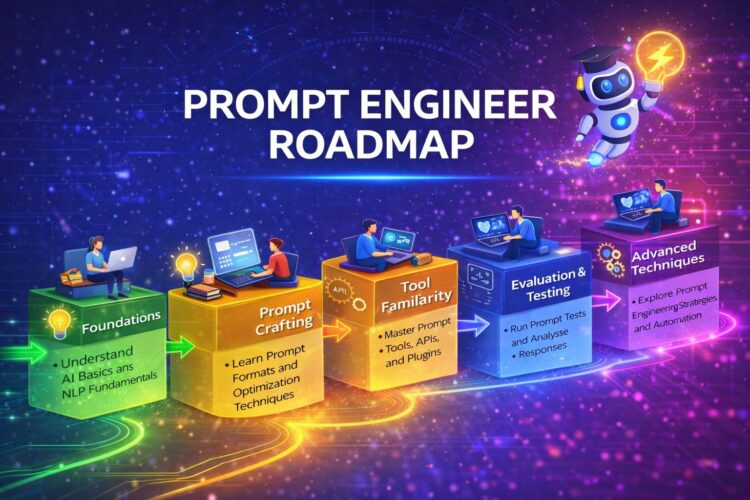
Prompt Engineer Learning Path (Step-by-Step Summary)
This learning path outlines the recommended order to build prompt engineering skills, from fundamentals to production-ready usage. It focuses on understanding, practice, and real-world application rather than memorization.
- Understand AI & Language Model Basics
Learn how large language models respond to instructions, context, and examples. Focus on limitations, strengths, and common failure cases. - Learn Core Prompt Structures
Practice basic prompt formats such as zero-shot and few-shot prompts. Understand how clarity, constraints, and examples influence output. - Apply Advanced Prompt Techniques
Work with structured prompts, reasoning steps, and task decomposition. Learn how to guide models through complex instructions reliably. - Test, Evaluate, and Refine Prompts
Compare outputs, identify inconsistencies, and refine prompts to improve accuracy, tone, and reliability. - Use Prompts in Real Applications
Apply prompt engineering in workflows such as chatbots, content generation, data analysis, and internal tools. - Prepare for Production Usage
Learn prompt versioning, reuse strategies, and collaboration practices used in professional environments.
Professional Prompt Engineering Courses & Certifications
While prompt engineering can be practiced independently, structured courses help learners understand proven techniques, evaluation methods, and real-world usage. The following courses are suitable for beginners to professionals and offer completion certificates.
Security & Safety: A Hidden but Critical Responsibility
This is where many “AI articles” fail — but companies do not.
Prompt Engineers must understand AI security risks, such as:
-
Prompt injection attacks
-
Data leakage through prompts
-
Unauthorized instruction override
-
Sensitive information exposure
In real jobs, Prompt Engineers help:
-
Restrict what AI is allowed to answer
-
Prevent users from manipulating prompts
-
Ensure confidential data is not leaked
This is why Prompt Engineering is increasingly connected to:
-
AI security
-
Compliance
-
Governance roles
Read More: AI Engineer Career Roadmap 2026
Prompt Engineer Salary Reality: India vs USA (2024–2026 Snapshot)
Important note:
“Prompt Engineer” is rarely a fixed title. Salaries are usually bundled under AI Engineer, Applied AI Specialist, ML Engineer, or Solutions Architect roles. What you are paid for is responsibility and system impact, not the prompt-writing label.
Salary Table (Realistic Ranges)
| Level | USA (Annual) | India (Annual) | Reality Check |
|---|---|---|---|
| Beginner (Using Prompt Engineering inside another role) |
$70k – $90k | ₹6 Lakh – ₹12 Lakh | Not a standalone job. Prompt Engineering acts as a skill premium added to roles like Analyst, Developer, Marketer, QA, or Support. |
| Practitioner (Prompt Engineer / AI Specialist) |
$110k – $160k | ₹15 Lakh – ₹30 Lakh | Real job postings exist. Requires a portfolio showing complex prompts, workflows, hallucination control, and business use cases. Strong demand in tech hubs. |
| Advanced / Specialist (AI Engineer / LLM Engineer) |
$160k – $300k+ | ₹30 Lakh – ₹70 Lakh+ | Requires RAG, evaluation, security, and software integration skills. Often combined with Python, APIs, and system design. This is where salaries accelerate. |
Future Salaries & Upcoming Changes
-
Near-term (1-2 years): Salaries for pure “prompt whisperers” may plateau or dip slightly as the skill becomes more common. However, specialist salaries will soar. The value will shift from knowing syntax to solving business problems.
-
The Big Shift: AI-Native Tools. Future tools (like Devin for coding or Sora for video) will have different interfaces. The core skill won’t be “writing prompts,” but “defining problems in a way an autonomous agent can solve.”
-
Future-Proof Skills: The ability to evaluate AI output critically, manage AI workflow systems, and fine-tune small, specialized models will be paramount. Prompting will become one tool in a larger toolkit.
Pros and Cons: The Unvarnished Truth
- High Leverage: Small efforts can generate enormous value.
- Barrier to Entry is Low: Anyone can start today.
- Intellectually Rewarding: It’s a new, evolving puzzle.
- Cross-Domain: Applicable everywhere.
- Fluid Target: Tools and best practices change monthly.
- Frustration is Guaranteed: It’s part of the process.
- “Black Box” Nature: Sometimes, you won’t know why a prompt fails or works.
- Standalone Role Uncertainty: The long-term viability of a “Prompt Engineer” title is debated.
Frequently Asked Questions (FAQs)
Q: Will AI learn to prompt itself, making this job obsolete?
A: Partially. Basic prompting will be automated. But the strategic role of designing the interaction framework, setting guardrails, and integrating domain knowledge will become more critical. It will evolve, not disappear.
Q: Do I need to be a programmer?
A: For beginner/practitioner level, no. For advanced/specialist roles, yes, absolutely. You’ll be working in code environments.
Q: What’s the single best way to learn?
A: Learn by doing. Pick a real, tedious task from your work or hobby. Try to automate or enhance it with AI. Fail, tweak, and succeed. This portfolio of solved problems is your best credential.
Q: Are certifications worth it?
A: They can provide structure. But a public portfolio (GitHub with prompts, a blog deconstructing techniques) is infinitely more valuable to employers.
Q: Is Prompt Engineering a real career?
A: Yes. Companies use it to control AI behavior.
Q: Will AI replace Prompt Engineers?
A: No. It increases the need for skilled control.
Q: Is Prompt Engineering future-proof?
A: Yes, as a foundational AI skill.
Conclusion: The Human in the Loop
At its best, Prompt Engineering is not about learning a machine’s language.
It is about mastering the clarity of your own thinking and expressing it with precision, structure, and responsibility.
- This roadmap shows a clear progression:
from a casual chatbot user → to a professional who designs reliable human–AI interactions → to a strategic contributor shaping how AI is safely used inside real systems. - The future will not belong to those who fear being replaced by AI.
It will belong to those who learn how to partner with it deeply and responsibly. - That partnership does not begin by copying prompts from the internet.
It begins by understanding why prompts work, how AI fails, and how human judgment guides machine output. - Tools will change. Models will improve. Interfaces will evolve.
But the core skill — structured, logical, human communication — remains timeless.
The market has always rewarded — and will continue to reward — people who deliver real, measurable value by unlocking the true potential of these powerful tools.